By Brooke Heinz, Speech-Language Pathologist | Overwhelmed Mom
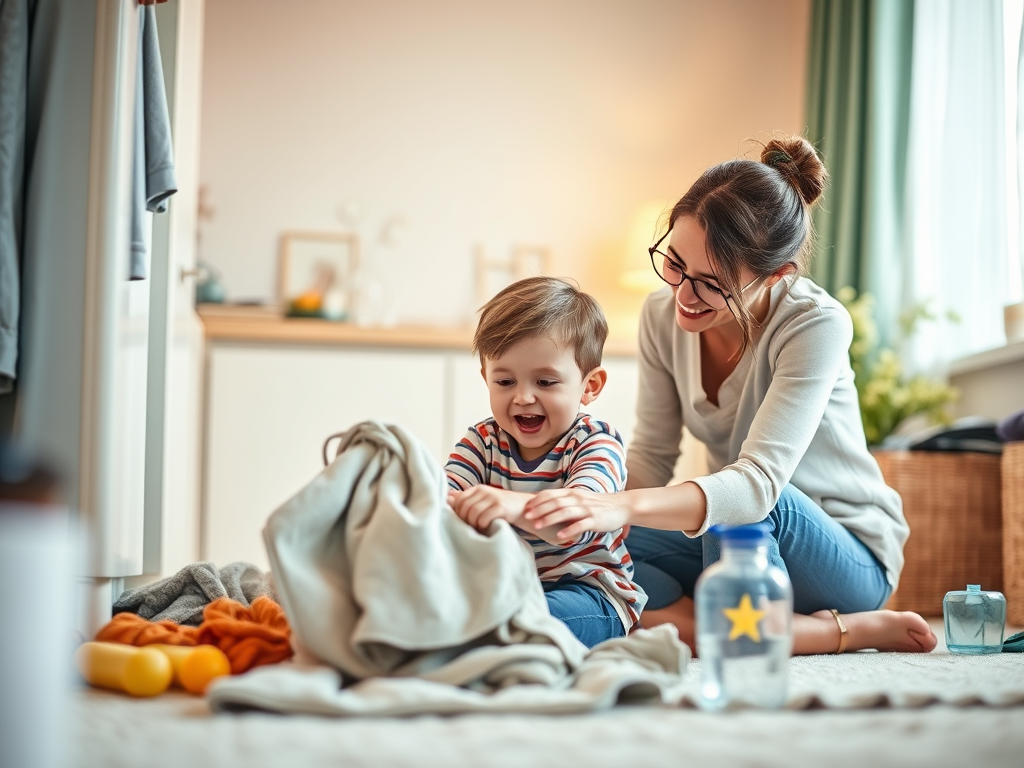
One of my ongoing life challenges has two parts 1) how to keep my house liveably clean and 2) how to teach my now three-year old son to clean. The answer to the first part lies in one of the million cleaning systems and routines that are available and I’ll let you know when (if?) I find one that works well for me. Teaching my son to clean has been an interesting task.
Why am I teaching my three-year old to clean?
Last year, I read Durenda Wilson’s book Raising Boys to Men. In it, she recommended starting chores as soon as kids are able. Early participation in chores leads to a whole bunch of developmental benefits, including:
- building responsibility
- developing intrinsic motivation
- creating empathy
- building executive function skills
- leads to better adult outcomes in health, relationships, and career (see references below).
The problem
When my son was two, this was easy. He had high motivation to help, but low skills. Unload the dishwasher? Absolutely! Carry in the groceries? As long as I can drop the milk! Vacuum? A little scary, but okay! Now that he’s older, his skills have improved, but his motivation has tanked. He’s still happy to carry in groceries (gotta show off those muscles), but every other task is getting more and more difficult.
The solution
The solution is simple – make it fun. Simple, but challenging. How on earth do you make chores fun? Especially when your creativity has been sapped by sleep-deprivation, crying babies, and endless playing? In my brain-foggy haze, my mind has sluggishly generated a couple of ideas.
Idea #1: Find the home
The first was helping my sons’ clothes find their home. We’d have t-shirts, underwear, and other clothing items asking to be placed in their home because they were scared or tired.
Pros: Fun, initially engaging, clothes made it into the drawers
Cons: I ran out of steam on this one (sometimes you just can’t find right voice for socks). Also, after a while, my son started saying, ‘no!’ when his shirts asked to be put back.
Idea #2: Mess Monster
I told my son that we had a mess monster in our house and I needed his help to get rid of it. “Mess monsters,” I said, “like to live where it’s messy, so they try to make houses as messy as possible so they can be comfortable. Right now, we have a big mess monster in our house and I need your help to get rid of him.” Then we went through the house, finding spots where the mess monster had left dirty (and clean) clothes on the floor, trash on counters, misplaced toys.
Pros: This one is really fun and keeps the blame for mess off any particular person in the family (which is good because we all contribute to the mess)
Cons: We didn’t defeat the mess monster in one day, and my son later in the week said he wanted a mess monster to live our house (surprising given that he keeps hiding my sons toys).
How do you get your threenagers excited for cleaning? Let me know in the comments below!
📚 References: Why Early Chores Matter for Child Development
- Rossmann, M. M. (2002) – University of Minnesota Extension
A long-term study found that children who started chores as early as ages 3–4 were more likely to become successful adults with strong relationships and careers.
👉 Read the study (PDF) - The Harvard Grant Study (Vaillant & Mukamal, 2001)
One of the longest-running studies on human development showed that helping with chores builds a lifelong “pitch-in” mindset that supports success, emotional health, and resilience. - Dunn, Gray, & Munn (1994) – Developmental Psychology
Children involved in family routines and household responsibilities were more socially skilled and emotionally competent.
👉 View the abstract - Wuytack & Craig (2012) – Children’s Geographies
Giving kids choice in chores promotes motivation, a sense of agency, and confidence in their role at home.
👉 Read more - Eisenberg, Fabes, & Spinrad (2006) – Handbook of Child Psychology
Helping at home encourages prosocial behavior—like empathy, cooperation, and emotional self-regulation. - American Academy of Pediatrics (AAP)
The AAP recommends giving children age-appropriate chores as part of positive parenting that builds life skills and family connection.
👉 HealthyChildren.org – Chores for Children - Center on the Developing Child – Harvard University
Everyday tasks like chores help develop executive function—skills like working memory, planning, and self-control—that are essential for lifelong success.
👉 Read the article - University of California, Berkeley (2018)
Research summaries from UC parenting workshops suggest that meaningful contributions at home boost kids’ self-esteem and family connectedness. - Wilson, D. (2023). Raising Boys to Men: A Simple, Mercifully Short Book on Raising and Launching Boys.
In this book, veteran homeschooling mom and parenting author Durenda Wilson shares practical wisdom and encouragement for raising boys to become responsible, mature, God-honoring men—including giving them real responsibilities at home.





 Speechy Life
Leave a comment