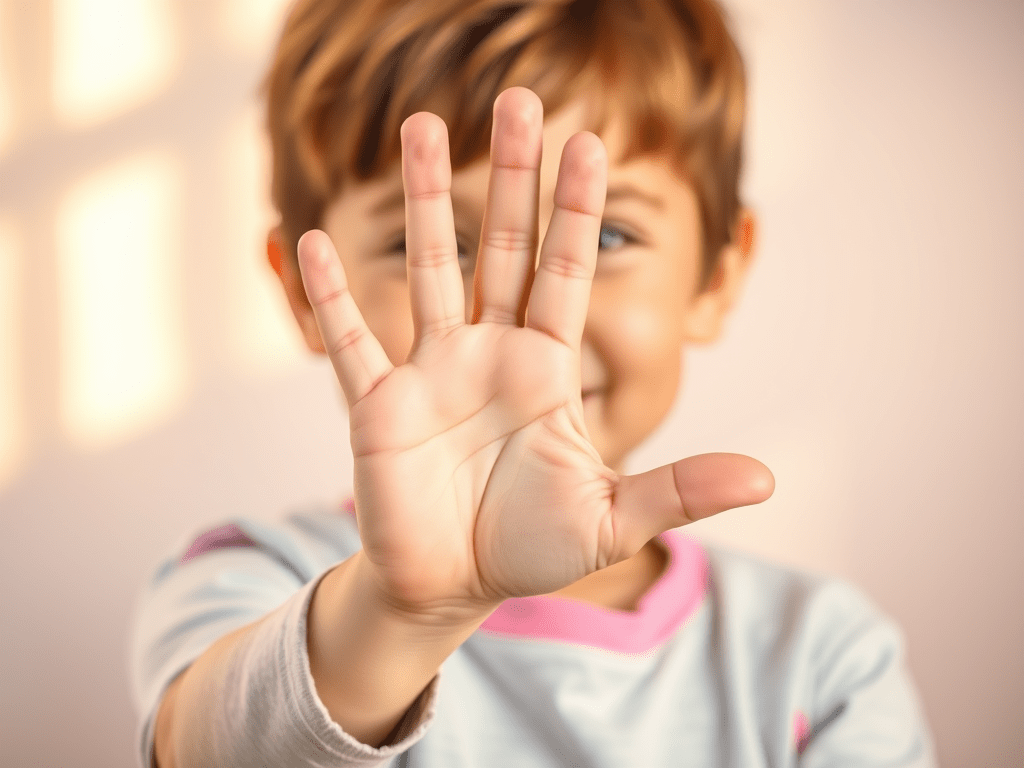
When children experience big emotions—frustration, anxiety, sensory overload—it can be hard for them to calm down on their own. As caregivers, therapists, and educators, one of the most helpful tools we can teach is five-finger breathing: a calming, tactile, and visual strategy that kids can carry with them anywhere.
🖐️ What Is Five-Finger Breathing?
Five-finger breathing is a mindful breathing exercise that uses the hand as a visual and kinesthetic guide. It helps children slow their breathing, focus their minds, and re-center during moments of dysregulation. It’s simple, powerful, and can be used anywhere—from classrooms to car rides.
✋ How to Do Five-Finger Breathing (Step-by-Step)
- Hold up one hand like a star—fingers spread wide.
- Use the index finger of your other hand to slowly trace up the outside of your thumb as you breathe in through your nose.
- Pause at the top of your thumb.
- Slowly trace down the inside of your thumb as you breathe out through your mouth.
- Continue tracing up and down each finger, breathing in on the way up and out on the way down.
- Once you’ve traced all five fingers, pause, close your eyes (if comfortable), and notice how your body feels.
🧘♀️ Pro Tip: You can say a calming phrase like “I am safe” or “Breathe in calm, breathe out worry” to pair breath with self-talk.
💡 Why It Works
- Tactile and visual anchor: Engaging the hands and eyes helps keep focus during big feelings.
- Bilateral movement: Crossing midline by using both hands activates the brain and can support regulation.
- Predictable rhythm: Inhale/exhale timing helps reset the nervous system and reduce anxiety.
📚 Recommended Emotional Regulation Books
Pairing breathing strategies with books and characters that explore feelings can deepen understanding and help kids integrate the skills. Here are a few trusted favorites:
🧸 Slumberkins Books
These beautifully illustrated stories pair with snuggly creatures and are designed by educators and therapists to promote emotional intelligence.
- Slumberkins Bigfoot: Believes in You – Focuses on self-esteem and perseverance.
- Slumberkins Alpaca: Holds Your Worries – Supports stress relief and worry management.
- Slumberkins Snail: Feels Calm – Great for teaching mindfulness and slowing down.
🛒 Or browse more Slumberkins titles and creatures: Slumberkins on Amazon
🟡 Spots of Emotion (Diane Alber)
These books use bright visuals and simple language to teach kids how to identify and respond to emotions.
- A Little SPOT of Emotion Box Set (8 Book Set) – Covers a range of emotions: anger, happiness, sadness, anxiety, and more.
- A Little SPOT of Anxiety: A Story About Calming Your Worries – Perfect pairing with five-finger breathing.
🧠 Evidence-Based Support
Research supports that mindful breathing is a powerful tool for self-regulation in children:
- Siegel, D. J., & Bryson, T. P. (2011). The Whole-Brain Child.
Shows how breath-based strategies help activate the prefrontal cortex, supporting emotion regulation. - Semple, R. J., et al. (2010). Mindfulness-based cognitive therapy for children.
Demonstrates improvements in anxiety, emotional regulation, and attention with breath-centered practices. - Schonert-Reichl, K. A., & Lawlor, M. S. (2010).
Found that school-based mindfulness programs including deep breathing improved emotional control and empathy in children.
Journal of Applied School Psychology, 26(1), 70–95.
💬 Final Thoughts
Teaching kids five-finger breathing gives them more than a coping skill—it gives them a sense of agency. Whether you’re a parent, therapist, or teacher, this simple strategy can be the first step in helping a child learn that they can calm their body and brain, one breath at a time.
📝 Click below for a free downloadable PDF for 5-Finger Breathing
Also, if you’d like more printables and breathing techniques, check out Sarah’s Mindful Haven




 Speechy Life
Leave a comment