By Brooke Heinz, Speech-Language Pathologist | Recovering Doom-Scroller
When a parent first hears that their child has a language disorder, one of the questions they often ask is: Why? What causes a language disorder?’ My answer is usually somewhere along the lines of: ‘We don’t know exactly what causes a language disorder– researchers have found that it’s some combination of genetics and environmental factors. However, there are plenty of kids who have less than ideal language input and they don’t end up with a language disorder and vice versa. No, we don’t know exactly what causes a language disorder, but there are some things that absolutely do NOT promote language development and the number #1 thing on that list is screen time.
I’m not talking about screen time for the kids–although there’s growing research that screens are NOT great for children’s mental health and cognition. It’s screen time for parents that can get in the way of kids learning language.
How?
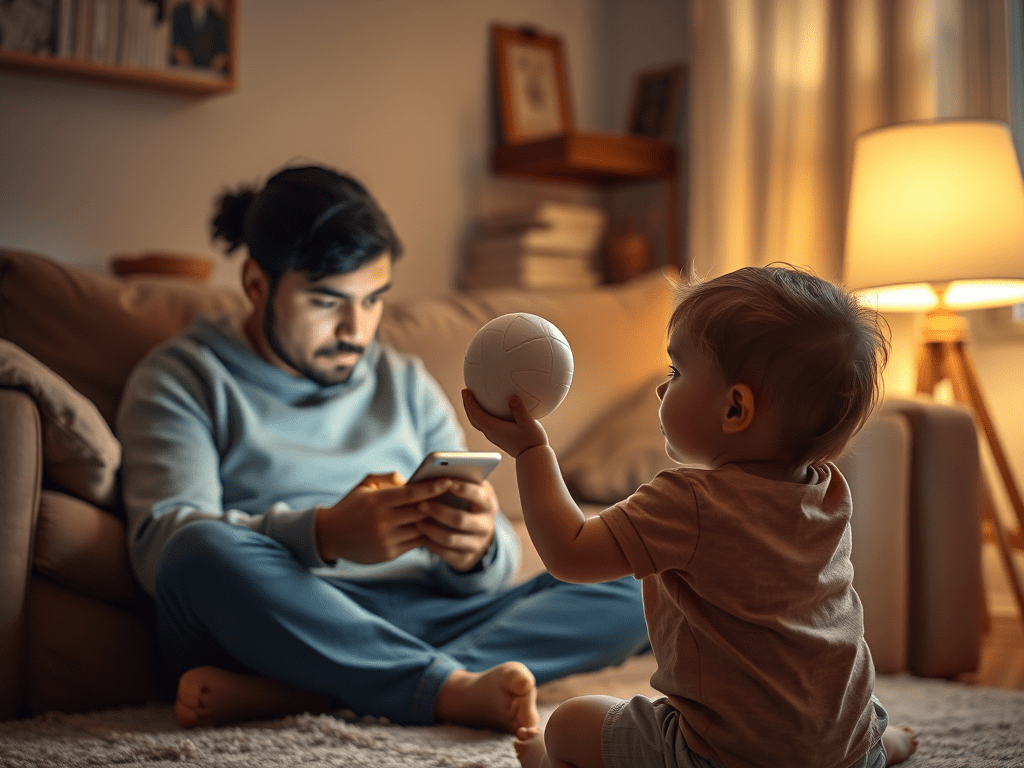
Infants and toddlers learn language through interaction. A child holds up a ball, parent says ‘Ball! You have a ball!’ The child then stores that information and after experimenting with many spherical objects and reinforcing that knowledge, you’ll hear the child say, ‘ball’ or ‘ba’ (speech sounds take practice). Now imagine that scenario with parents on their screen.
Child: *holds up ball*
Parent: *scrolls on their phone and doesn’t see the ball*
The problem is, even when you put away the phone, adults can still be distracted. Let’s look at the scenario from before.
Child: *holds up ball*
Parent: *washes dishes and doesn’t see the child holding up the ball*
With phones and other distractions, parents are missing opportunities to teach and interact with their children. Here are some tips on how to create a language-rich environment.
Tips for creating language-rich interactions
#1 Put away your phone–Place your phone in your pocket or in another room if you can. This lessens the temptation to check your phone when you’re bored. When you notice you’re on your phone again, put the phone away.
#2 Follow your Child’s lead–This is an actual strategy coined by the Hanen Centre, a company that specializes in programs, strategies and research for early language development. It means you face your child, notice what’s capturing their attention, and comment on it.
#3 Comment on what you’re doing–act like Mr. Rogers and tell your child what you are doing throughout the day. ‘ It’s time to wash our hands. Let’s walk over to the sink. Let’s turn the water on. Let’s get some soap. Scrub, scrub, scrub. Let’s rinse. Turn off the water. It’s time to dry our hands. All done.’
Remember, we don’t know what causes a language disorder. Putting away your phone helps you pay attention to your little one and tell them what you see. It also reinforces the bond they have with the most important person they have in their life: you.
References
American Psychological Association. (2025, June 9). Screen time and emotional problems in kids: A vicious circle? [Press release]. https://www.apa.org/news/press/releases/2025/06/screen-time-problems-children
The Hanen Centre. (n.d.). Home. Retrieved from https://www.hanen.org/home
Muppalla, S. K., Vuppalapati, S., Pulliahgaru, A. R., & Sreenivasulu, H. (2023). Effects of Excessive Screen Time on Child Development: An Updated Review and Strategies for Management. Cureus, 15(6), e40608. https://doi.org/10.7759/cureus.40608






 Speechy Life
Leave a comment